Launch of the Peace Building Fund project
Speech by the UN Resident Coordinator at the Launch of a Peace Building Fund Project in Qeme.
Bo Mme le Bo-Ntate, Khotsong!
Allow me to pay my respects to:
HIS MAJESTY KING LETSIE III
THE RIGHT HONOURABLE THE PRIME MINISTER
HONOURABLE MEMBERS OF HIS MAJESTY’S CABINET, IN PARTICULAR THE MINISTER OF HOME AFFAIRS, THE MINISTER OF GENDER, THE MINISTER OF JUSTICE AND LAW AND THE MINISTER IN THE PRIME MINISTERS OFFICE WHO ARE ALL PRESENT HERE TODAY
PRINCIPAL CHIEFS
HONOURABLE MEMBERS OF PARLIAMENT
THE DISTRICT ADMINISTRATOR
YOUR EXCELLENCIES, MEMBERS OF THE DIPLOMATIC CORPS & HEADS OF UN AGENCIES, IN PARTICULAR THE OHCHR REGIONAL REPRESENTATIVE AND UNDP REPRESENTATIVE HERE TODAY
DISTINGUISHED GUESTS
LADIES AND GENTLEMEN
ALL PROTOCOL OBSERVED
Bo ‘M’e le Bo Ntate,
Today, we gather not only to mark the beginning of a new initiative but to celebrate the strength, resilience, and unity of our communities. We come together with a shared belief — that Lesotho can be a place of peace, of dignity, and of hope for all its people. We gather as partners, united by a vision of a safer, more just future.
It is this shared purpose that brings light even in the face of hard truths.
While we are proud of our progress and the partnerships we have built, we must also face the realities that continue to challenge us. Lesotho is grappling with deeply troubling levels of violence. Our nation currently has the highest rate of homicide in Africa and ranks fifth in the world. The World Population Review Report (2022) reveals that 86% of Basotho women have experienced gender-based violence in their lifetime. Over 40% have suffered abuse from an intimate partner.
These are not just numbers. They are the lived experiences of mothers and daughters, sons and brothers — they speak to a pain that touches every corner of our society. And they compel us to act.
As former UN Secretary-General Kofi Annan wisely said: “There can be no peace without development, no development without peace, and neither peace nor development without human rights.”
It is in this spirit that we launch this project today — a milestone shaped by years of listening, learning, and working side by side. This launch is more than a ceremony; it is a commitment to a different kind of peace. Not peace defined only by the absence of violence, but by the presence of dignity, inclusion, safety, and opportunity for all.
Bo-‘M’e le Bo-Ntate,
Peace cannot be imported. It cannot be imposed. It must be nurtured in our families, our villages, and in our hearts. The kind of peace we seek for Lesotho must begin at the community level — where daily life happens, where conflict often begins, and where it must be resolved not with fear, but with fairness; not through silence, but through dialogue.
That is why we chose to hold this launch here, at the grassroots. Because violence often begins not in parliaments or courtrooms, but in places where hope has withered, where youth feel invisible, and where justice seems distant. And so, healing and transformation must begin here too.
This initiative is part of a broader journey that started with Lesotho’s national reforms, including critical justice and security sector reforms. We’ve made bold strides: from training security forces, to strengthening institutions, to designing mechanisms that safeguard rights. But laws alone are not enough. Reform must be felt in how people live, how they are protected, and how they are heard.
This project brings those reforms to life.
Through strong partnerships with local councils, traditional leaders, police, courts, and civil society, we are investing in community-led solutions. We are creating spaces for dialogue, reconciliation, and understanding. We are building trust between people and the institutions that serve them. And we are strengthening community policing units that operate not above communities, but alongside them.
Crucially, we are placing women, youth, and children at the heart of this effort. Too often, they bear the heaviest burden of violence — and yet they are also the drivers of resilience and peace. Women rebuild what conflict tears apart. They comfort, protect, and hold families together. Let us not only safeguard their rights — let us uplift their voices, and empower their leadership.
An important pillar of this project is laying the groundwork for Lesotho’s National Human Rights Commission. This will be a historic step — bringing justice closer to ordinary citizens. No longer should a Mosotho need thousands of maloti to seek redress at the High Court. Rights must not only be written into law, they must be felt in daily life.
Bo-‘M’e le Bo-Ntate,
The founding of the Basotho nation was rooted in the values of Khotso, Pula, Nala — Peace, Rain, and Prosperity. These are not just words. They are a promise — handed down from your ancestors. And today, they must guide us forward.
Before I conclude, I extend heartfelt thanks to the Peacebuilding Fund for their generous support. I also welcome the dedication of my UN colleagues — UNDP, OHCHR, and UN Women. This is what One UN in action looks like: coordinated, determined, and united behind the people of Lesotho.
To all stakeholders here today — please know: the United Nations family stands with you. We will walk this journey with you — every step of the way — until peace is not only a dream, but a daily reality for every Basotho.
Bo-‘M’e le Bo-Ntate,
Let us move forward together — government, communities, development partners, and the UN — hand in hand, heart to heart and ka lebelo la Nsthoekhe. Let us work for a Lesotho where every child grows up without fear, where every woman walks without danger, and where every village becomes a home of peace.
A safer world is possible.
Kea leboha.


Speech by
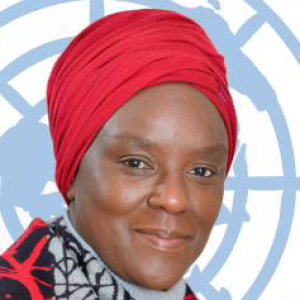
Ms. Amanda Khozi Mukwashi
Goals we are supporting through this initiative